
The modern literary landscape of Ireland is richer and more diverse than ever before. Among the voices that have emerged to tell new and complex stories is Cauvery Madhavan, an Indian-born writer who has made Ireland her home for over three decades. Through her novels, she bridges two worlds – the India of her birth and the Ireland of her adoption – offering readers a unique bicultural perspective that illuminates the deep and sometimes surprising connections between the two countries.
From Chennai to Sligo: A Journey Across Worlds
Cauvery Madhavan was born and educated in India. She began her career as a copywriter in Chennai, then known as Madras, working in an advertising agency. But her life took a dramatic turn in 1987 when she moved to Ireland. Her husband, a junior doctor who had just qualified, came first. He rang her and asked her to bring condoms, explaining they were only available on prescription in Ireland. She spent her last day in India scurrying between pharmacies and arrived in Ireland on Valentine’s Day with what she later called “a suitcase full of sin”.
The move was a shock. She left Madras, a city of 12 million people, and arrived in County Sligo, a county of just 12,000. In India, she had an idea of what the West was like – she was expecting “sex, drugs and rock’n’roll”. What she got was Catholic Ireland. She soon realised she had left a conservative country for an ultraconservative one.
But Madhavan loved Ireland from the beginning. She and her husband, both city folk, took to country life immediately. The green landscape, the easy access to nature, the warmth of the people – all of it drew them in. They thought they would stay for a few years, but her husband’s career kept them there. He specialised in vascular surgery, which was new in Ireland but non-existent in India at the time. After twelve years, they had the chance to stay permanently and grabbed it. Today, she lives between County Kildare and West Cork, with her soul firmly rooted in the Beara Peninsula.
Finding Common Ground: The Similarities Between Two Cultures
What helped Madhavan and her husband settle in Ireland was the realisation that the two countries shared a similar cultural outlook. Both societies obsess about families. In India, your aunt’s opinion is as important as your mother’s. It is similar in Ireland – the opinion of your extended family matters. Both cultures take pride in their families and do not want to let them down. Both societies obsess about births, marriages and deaths. There is a shared love of good food and drink. And both countries have an obsession with religion. Even though Catholicism is waning in Ireland, the ethos remains – it is in every aspect of life.
Madhavan’s own childhood in India was shaped by Irish influence. She went to seven different schools as a young child because her father served in the Indian Army Corps of Engineers. All seven schools were run by Irish nuns. India was truly secular then – a far more tolerant and accepting society than it is today. Christians, Muslims and Hindus grew up together and went to school together. She remembers attending midnight Mass on Christmas Eve six years in a row with her Catholic friends. These early experiences planted seeds that would later blossom into her literary career.
The Novels: Four Books, Four Perspectives
Madhavan has published four novels, each exploring different aspects of identity, belonging and the connections between Ireland and India.
Paddy Indian (2001)
Her debut novel, Paddy Indian, portrays an Indo-Irish cultural encounter on Irish soil. It offers a fictional insight into cultural translation and transculturalism, not only through its content but also through the characters’ use of language. The novel explores what happens when an Indian doctor moves to Dublin and navigates the complexities of Irish life. It was a pioneering work at a time when Ireland was still more known for emigration than immigration.
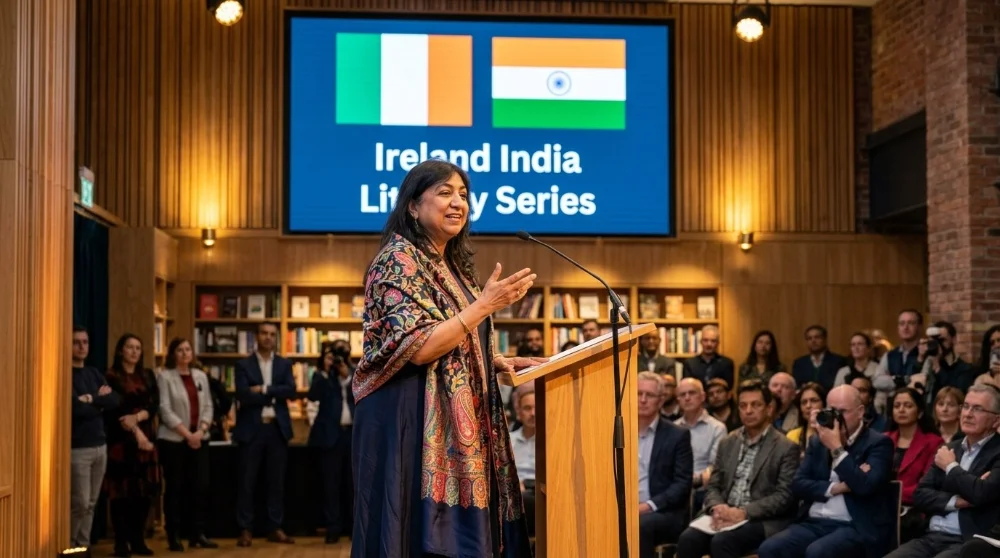
The Uncoupling (2003)
Her second novel, The Uncoupling, tells the story of Balu and Janaki Shankar, a traditional South Indian couple in their late fifties who have been married for 33 years in reasonable harmony. They take a trip to visit their son in the UK, and their marriage begins to unravel. It is a dark and comic account of the disintegration of a marriage, exploring themes of tradition, change and the gap between generations.
The Tainted (2020)
Her third novel marked a significant departure. Unlike her previous two books, The Tainted is a historical fiction that traces Irish-Indian connections in the 20th century. It was published exactly a hundred years after the events that inspired part of the novel.
The story was inspired by a conversation Madhavan overheard at an event in the Indian Embassy in Dublin twenty years earlier. The conversation was about the Mutiny of the Connaught Rangers in India in 1920. Intrigued, she looked up references to it the next day and was immediately drawn to the complex story and its tragic outcome.
The novel has two strands – one set in 1920 and the other in the early 1980s. It aims to highlight convergences in responses and resistance to violent British colonial rule. Madhavan rewrites the historical episode of the Connaught Rangers mutiny and, in blending fact and fiction, raises uncomfortable questions about victimhood and agency in post-colonial contexts.
The story delves into the minds of people whose lives and loyalties are caught in a social and historic limbo. Irish Catholic soldiers in the British army. Anglo-Irish officers who commanded them. And Anglo-Indians – children that these soldiers fathered in marriages and liaisons with Indian women and who they, more often than not, abandoned.
Madhavan spent years researching the novel. She travelled dozens of times to India, as well as to various locations in Ireland and the UK. She visited old army barracks, parade grounds and regimental messes. She researched military chaplaincy for six months. The result was a novel that explores issues of identity and belonging, as well as the terrible repercussions of race, class and religious prejudice in both India and Ireland.
The Tainted was chosen by Laureate Sebastian Barry for his Laureate Picks 2020. It has since been studied on university syllabi in the United States.
The Inheritance (2024)
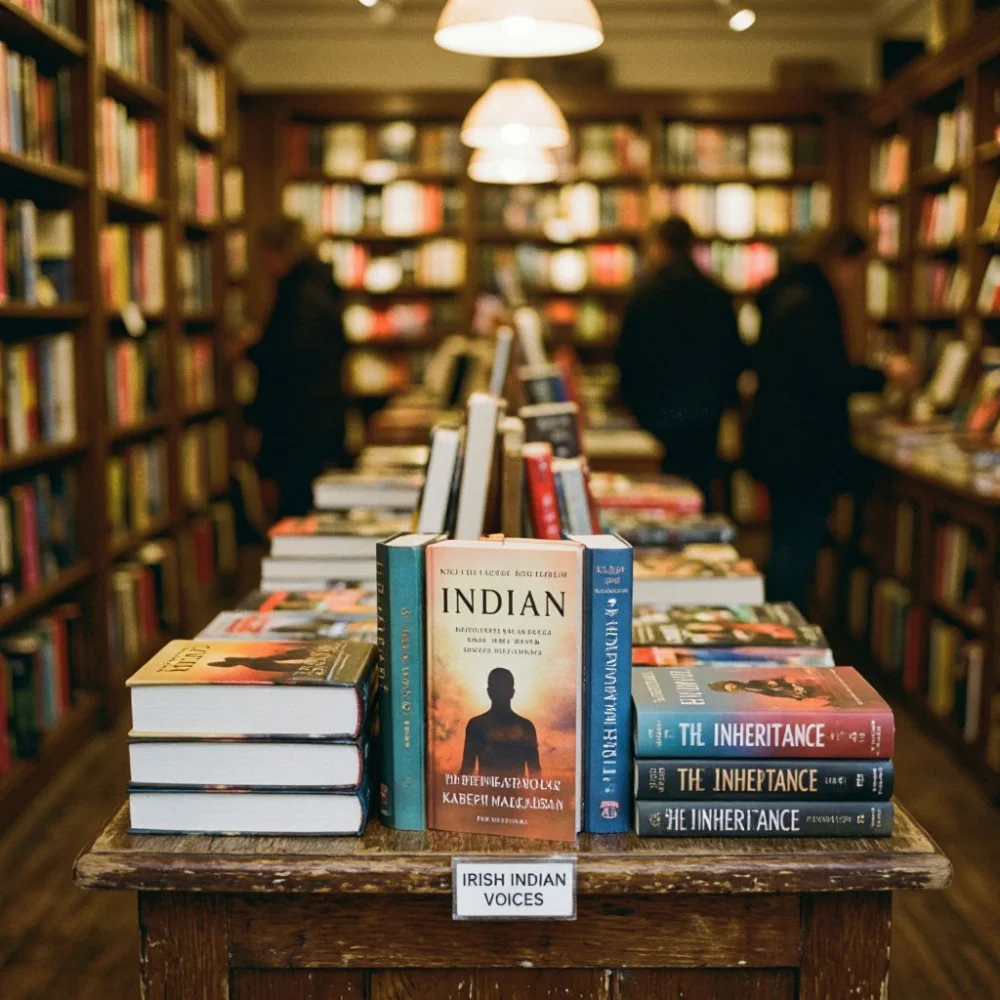
Her most recent novel, The Inheritance, was published in September 2024. It won the Fiction Award at the Eastern Eye Art, Culture and Theatre Awards (ACTAs) 2025. The book intricately weaves together two timelines set in Ireland’s Beara Peninsula – one in 1986 and the other in 1602.
The modern story follows Marlo O’Sullivan, a 29-year-old London-Irish man who discovers that his sister is actually his mother. To steady his life, he moves to Glengarriff on the Beara Peninsula, to a cottage he has inherited. There he meets Kitty, a single mother, and Sully, her non-verbal six-year-old son.
Interwoven with this is a haunting tale from 1602, portraying the retreat of Dónal Cam O’Sullivan Beare through the eyes of a mute boy named Cloichín. The two stories, though separated by 400 years, are tied together as the characters seek their identities and find peace as they come to terms with loss and the power of forgiveness.
The kernel of the idea came from an overheard conversation at a kitchen table that she stewed on for 20 years. Madhavan’s deep personal connection to the Beara Peninsula – where she owns a holiday home – lends authenticity and emotional richness to the narrative.
Renowned authors have praised the work. Donal Ryan described it as “a novel that evokes the place and people with such tenderness and insight and love”. Graham Norton commended its unique perspective on the West Cork region. In fact, Madhavan got the book to Norton through a truly West Cork experience – passing it through the Bantry Bookshop, who passed it to Norton’s favourite fishmonger. Norton responded with praise and admiration.
The novel explores universal themes of identity, belonging and the legacy of history on present lives. As Madhavan explains, “There is nobody in Ireland who doesn’t know somebody with a related story”. It is also, more than anything, a love letter to West Cork.
A Voice for Diversity and Inclusion
Beyond her novels, Madhavan contributes regularly to The Irish Times. She has written on topics ranging from yoga and Catholicism to the politics of history and memory. She has played an important role in nurturing emerging voices through creative writing workshops for immigrant writers at the Irish Writers Centre.
She was featured in the Irish Writers Centre’s video series Dublin: One City, Many Stories, which explores identity, belonging and creativity through the voices of writers who have made Ireland their home. In the series, she reflected on what it means to write, live and belong in contemporary Ireland. She said: “Curiosity is essential for any writer – and in Ireland, curiosity is part of who we are”.
She was named the 2026 Charles A. Heimbold Jr. Chair of Irish Studies at Villanova University, a recognition of her significant contributions to Irish literature and her unique perspective as an Indian-born Irish writer.
A Bridge Between Two Worlds
Cauvery Madhavan’s work stands at the intersection of two cultures. She writes about India with the intimacy of someone who was born there. She writes about Ireland with the affection of someone who chose to make it her home. She explores the connections between the two countries – the shared history, the similar cultural values, the complex legacies of empire.
Her bicultural perspective is not just a background detail. It is central to her storytelling. As she said, “Writing from the heart resonates far beyond home”. Her books have been praised by some of Ireland’s most celebrated writers and are now studied on university syllabi in the United States.
Her journey from Chennai to Sligo, from copywriter to award-winning novelist, is a testament to the power of storytelling to bridge divides. Through her work, Cauvery Madhavan continues to enrich Irish literature with new voices, new perspectives and a deeper understanding of the ties that bind Ireland and India together.


