In September 2024, something remarkable happened in Kolkata. The city’s famous Durga Puja festival – the world’s largest public art festival – took on an Irish dimension. Irish and Indian artists came together to create a pandal that honoured two powerful goddesses: the Hindu goddess Durga and the Celtic goddess Danu. It was a collaboration that celebrated not just art, but the shared values of two cultures separated by thousands of kilometres.
The Festival That Brings a City to Life
Durga Puja is the major annual festival in Kolkata and the state of West Bengal. It pays homage to the Hindu goddess Durga and celebrates her victory over the evil demon Mahishasura. The festival unfolds over ten days, with the main festivities taking place during the last five days. It is not simply a religious event. Durga Puja is now proudly described as the world’s largest public art festival, attracting well over a million visitors each year.
Every year, community groups commission over 40,000 pandals – art installations featuring a clay idol of the goddess – with more than 3,000 of these in Kolkata alone. These pandals vary in size from giant pavilion-sized installations to small room-sized exhibitions. Each pandal has a theme and is built using a mix of materials and techniques. The festival in Kolkata was inscribed on the UNESCO List of Intangible Cultural Heritage of Humanity in 2021.
A Diplomatic Anniversary and a Creative Idea
The 2024 Durga Puja marked the 75th anniversary of diplomatic relations between Ireland and India. The Embassy of Ireland in New Delhi wanted to commemorate this milestone in a meaningful way. Ambassador Kevin Kelly had visited Kolkata for Durga Puja the previous year and was blown away by what he saw. He recalled Ireland’s St Patrick’s Day parade, where massive installations move through the streets, and immediately thought of Macnas, Ireland’s biggest spectacle arts company.
The embassy reached out to Behala Nutan Dal, one of Kolkata’s most celebrated Puja committees, through the consulate. The puja convenor, Sandipan Banerjee, asked his artist Sanjib Saha, who agreed to a partnership. The idea was simple but powerful: create a pandal that would honour both the Hindu goddess Durga and the Celtic goddess Danu.
The Artists Behind the Collaboration
Three artists from Macnas travelled to Kolkata: Johnny O’Reilly, Richard Babington and Lisa Sweeney. They worked alongside Sanjib Saha, the Indian lead artist. The collaboration had been planned for months through video conferencing and online meetings starting in April.
For Lisa Sweeney, the trip had a deeply personal meaning. On her first visit to India, she discovered she was back in the land of her great-great-great grandfather. He was a Brahmin from Uttar Pradesh who set sail from Calcutta for Trinidad in 1881. His name was Ayoda Prasad Misra, but he had to change it to Gayadeen because an upper caste man could not board the ship that was taking indentured labourers to work in sugarcane plantations. In between her work at the pandal, Sweeney visited the dock from where such ships would sail.
The artists were captivated by Kolkata. They found a strong sense of community and saw a clear connection between Danu and Durga, both revered as maternal figures. They marvelled at the skill of the local weavers and carpenters. Richard Babington said: “It is hard to believe what they can create out of clay and straw”. Johnny O’Reilly noted that in Ireland, baskets or frames would be thatched with willow sticks, “but bamboo slices, which you get here, are so much more flexible”.
The Goddess Danu Takes Shape
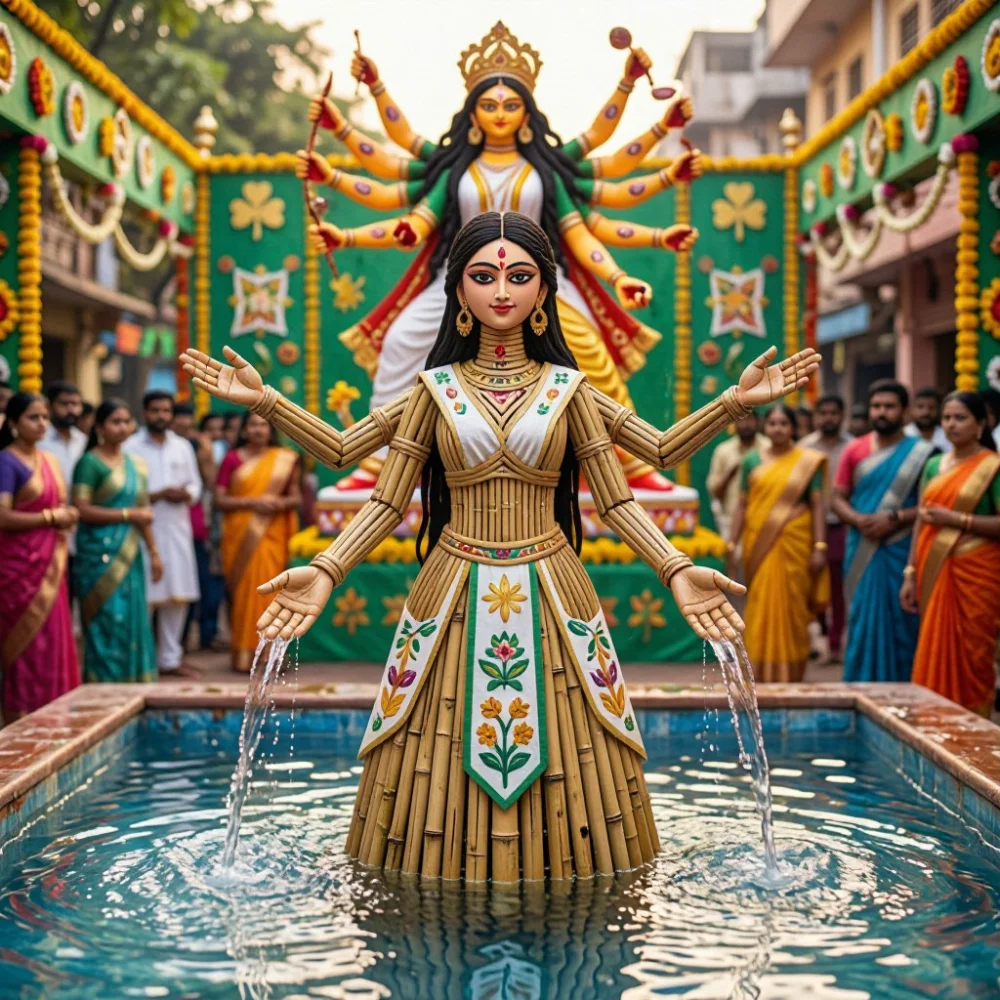
The centrepiece of the pandal was a large installation representing the Irish goddess Danu. Danu is the Celtic mother goddess associated with protection, strength, motherhood and war. Symbolising motherhood and warrior strength, Danu reflects qualities similar to those of the goddess Durga. Both are maternal figures who embody feminine power.
There are two known iconographies of Danu. The artists chose one where her palms are stretched and water sprinkles out, forming a pool at her feet. The structure was crafted using traditional materials such as iron, wood, bamboo and fabric. A small pool of water at her base created a rippling light effect, highlighting her connection to rivers and the life-giving force of water.
Danu’s welcoming form allowed visitors to pass beneath her outstretched arms. Her design incorporated motifs from Ireland’s four major festivals – Samhain, Beltane, Imbolc and Lughnasadh – along with a recurring flower theme that aligned with the overall design of the pandal.
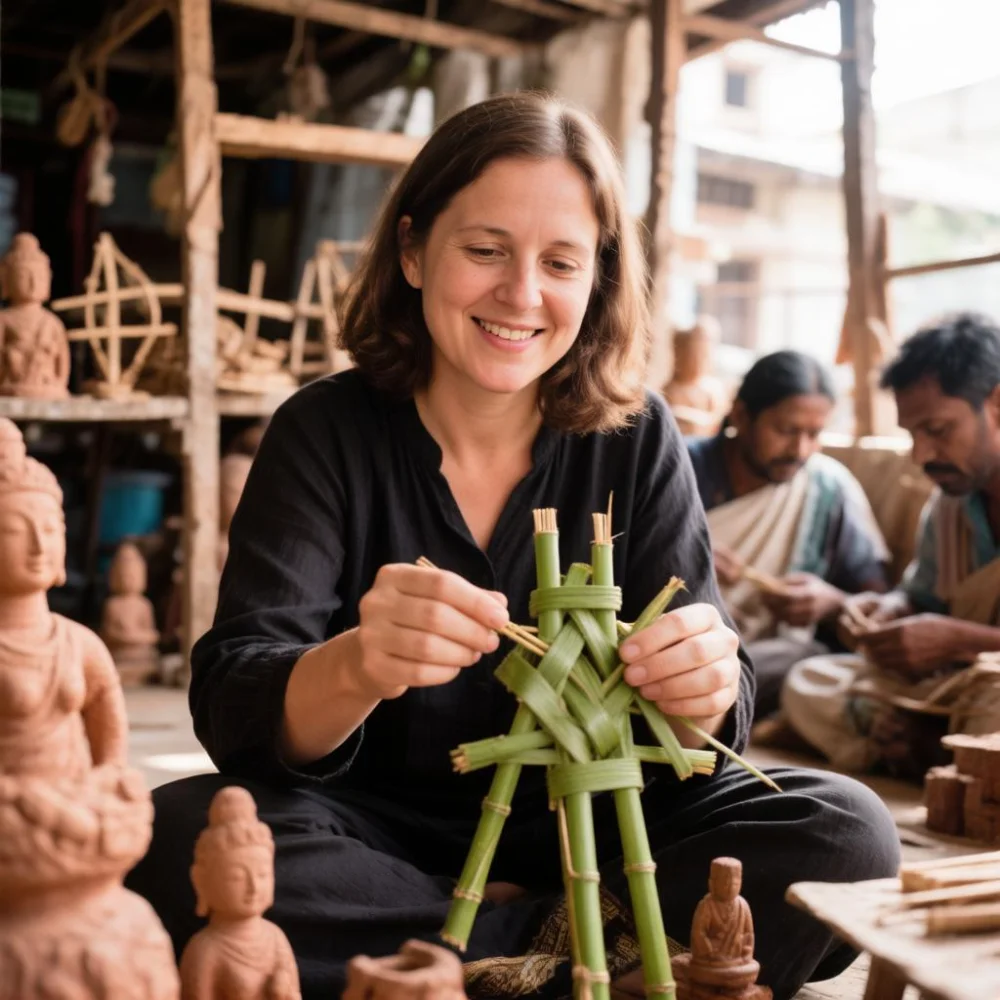
Lisa Sweeney added a personal touch. She made a traditional Irish cross, called Brigid’s cross, which is usually made from reeds from a field. She made it with bamboo instead, mixing an Irish design with a traditional Indian material.
A Fusion of Artistic Traditions
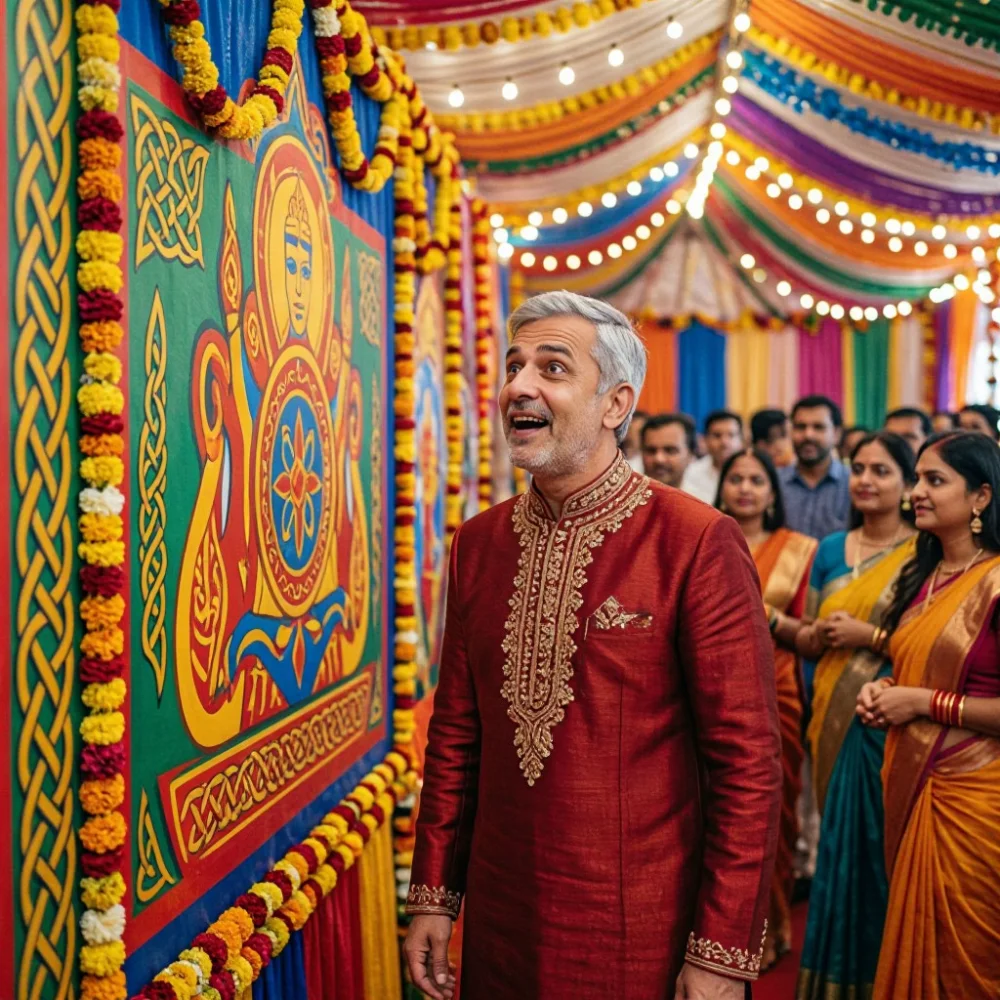
The pandal was titled ‘Kalpana’, meaning “imagination”. It was a unique, open-sided structure made of natural materials like bamboo and wood. The theme depicted a resemblance between Durga and Danu, marking the 75th anniversary of diplomatic relations between Ireland and India.
The collaboration was not just about installing an idol. Macnas contributed in two key ways: by designing a set piece that incorporated Irish cultural elements, and by working directly with Sanjib Saha to integrate their designs with his, creating a seamless and cohesive installation.
Ambassador Kevin Kelly, dressed in a red panjabi for the occasion, said: “Both Durga and Danu symbolise feminine power and women’s empowerment”. He added: “Durga Puja is one of the most awe-inspiring festivals I have ever witnessed. The energy, creativity, and community spirit are unparalleled”.
A Celebration of Shared Values
The collaboration was a powerful symbol of cross-cultural dialogue. Richard Babington said: “This fusion of Irish and Indian creativity will offer a visual spectacle that reflects the power of cross-cultural collaboration and celebrates the power of women and the feminine spirit”.
The Irish embassy noted that the partnership marked a significant cultural exchange and symbolised the growing global recognition of Durga Puja as a platform for cross-cultural dialogue. Ambassador Kelly said: “Ireland and India share a strong and growing partnership that transcends diplomatic relations. Our peoples are connected through education, culture and shared values”.
The initiative was supported by the Embassy of Ireland in New Delhi, the Department of Foreign Affairs, Culture Ireland, and Honorary Consul Mayank Jalan for West Bengal. It reflected the hard work of the talented Irish and Indian artists who worked tirelessly in Kolkata, dedicating themselves to bringing this vision to life.
A Lasting Bond
The collaboration between Irish and Indian artists to honour Durga and Danu was more than just an artistic project. It was a celebration of the deep and lasting connections between two nations. It showed that even gods and goddesses can cross borders, finding common ground in the values they represent – motherhood, strength, protection and the power of the feminine spirit.
For the millions who visited the pandal, it was a chance to see something they had never seen before: an Irish goddess standing alongside a Hindu goddess, two powerful women from two different cultures, united in a shared celebration of life, strength and creativity.