On the surface, Ireland and India appear to have little in common. They are separated by nearly 8,000 kilometres. Their climates, languages and lifestyles seem worlds apart. Yet beneath the surface lies a remarkable web of shared stories, myths and cultural motifs. These connections point to a shared kinship thousands of years ago that upends the concept of separation between eastern and western cultures.
A Common Ancestry
The similarities between Irish and Indian cultures are not coincidental. Both nations are descendants of the Indo-European peoples who migrated west to Europe and south-east to India from a central area between Russia, Ukraine and western Kazakhstan thousands of years ago. As one scholar noted, “There are men of the same Aryan descent by the Shannon and by the Indus whose ancestors had not their first common habitation by either river”.
This shared ancestry is reflected in language, social structures, traditions and belief systems. The web of connections is vast – vaster than the 8,000 kilometres and deeper than four millennia.
From the Panchatantra to Christy Moore
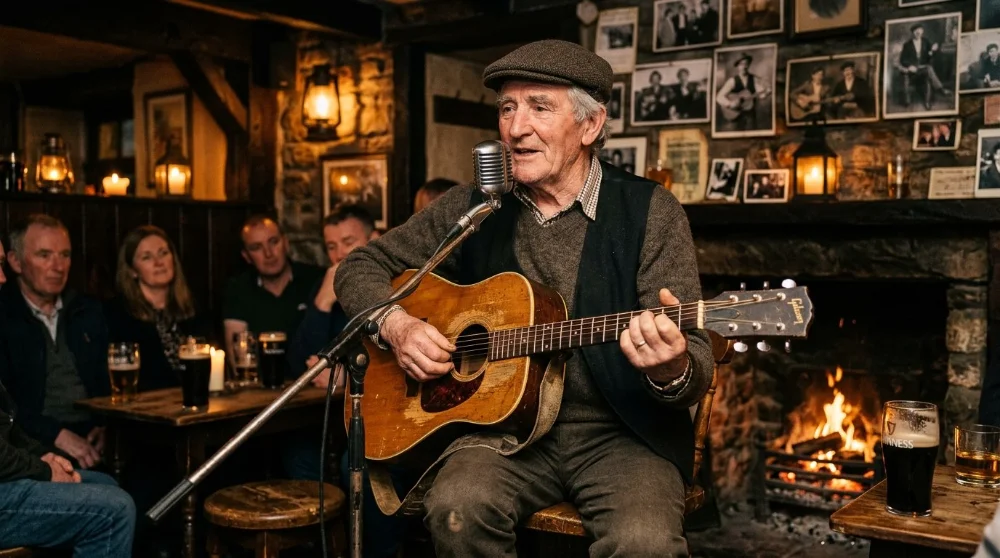
One of the most remarkable examples of shared storytelling involves a classic Irish folk song. When Christy Moore sings the traditional Irish song Tippin’ It Up to Nancy, he may not be aware that it derives from an ancient Indian collection of interrelated animal fables known as the Panchatantra – and yet it appears to.
Moore’s version, which he learned from the County Roscommon Traveller singer John Reilly, tells the story of an unfaithful wife who asks a chemist how to make her husband blind so that he won’t know about her infidelity. The chemist says: “Give him eggs and marrowbones and make him suck them all. Before he has the last one sucked, he won’t see you at all”. The husband goes blind and says he will drown himself in the river. His wife offers to show him the way, but he pushes her in instead.
The Sanskrit version, which dates from more than 2,000 years ago, tells a remarkably similar tale. An unfaithful wife asks the statue of a goddess at a river how to blind her husband. She hears the words: “If you never stop giving him such food as butter and butter-cakes, then he will presently go blind”. She does as advised, and her husband appears to go blind, but he tricks her and instead kills her lover and cuts off her nose.
The similarities are too close to be mere coincidence. The story travelled across continents and centuries, carried by traders, travellers and wandering storytellers, until it found a new home in the folk tradition of rural Ireland.
Druids and Brahmins: A Startling Kinship
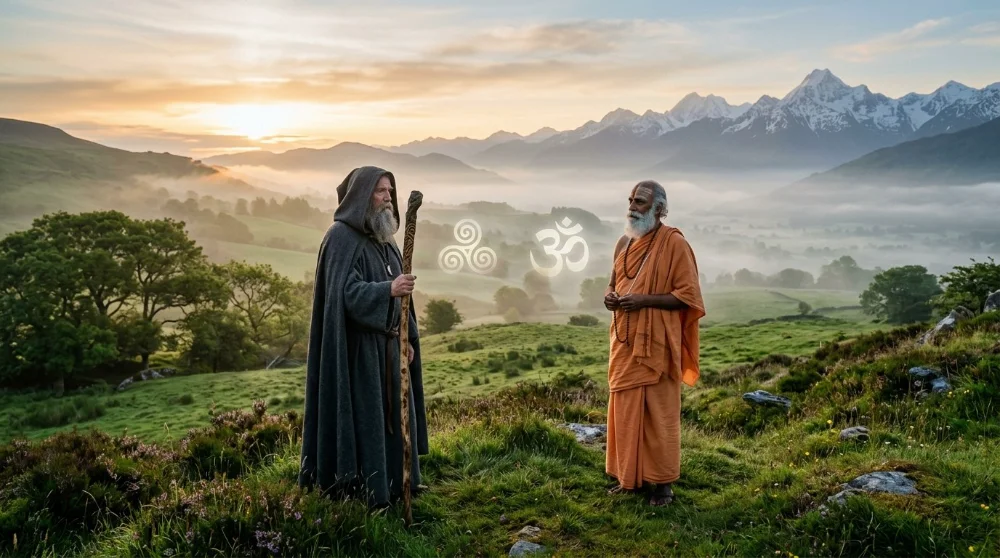
The parallels between Irish and Indian cultures extend far beyond individual stories. The Druids of the ancient Celtic world have a startling kinship with the Brahmins of the Hindu religion. Both were the intellectual caste of their societies, incorporating all the professions – judges, lawyers, medical doctors, ambassadors and historians.
The very name “Druid” is composed of two Celtic word roots which have parallels in Sanskrit. The root vid for knowledge also emerges in the Sanskrit word Veda. The Celtic root dru means “immersion” and also appears in Sanskrit. So a Druid was one “immersed in knowledge”.
The similarities between the social status of the druids and brahmins are remarkable. The ancient Irish law, known as Brehon Law, was declared by the Brehons, who have been described as “in fact as nearly as possible the Brahmans of India”. As Manchán Magan notes in his book Brehons and Brahmins: Resonances Between Irish and Indian Cultures, “There are social and judicial elements of the old Brehon law which is remarkably similar to the Indian brahmin law. So the commonalities are in language, law and lore”.
Mythological Parallels
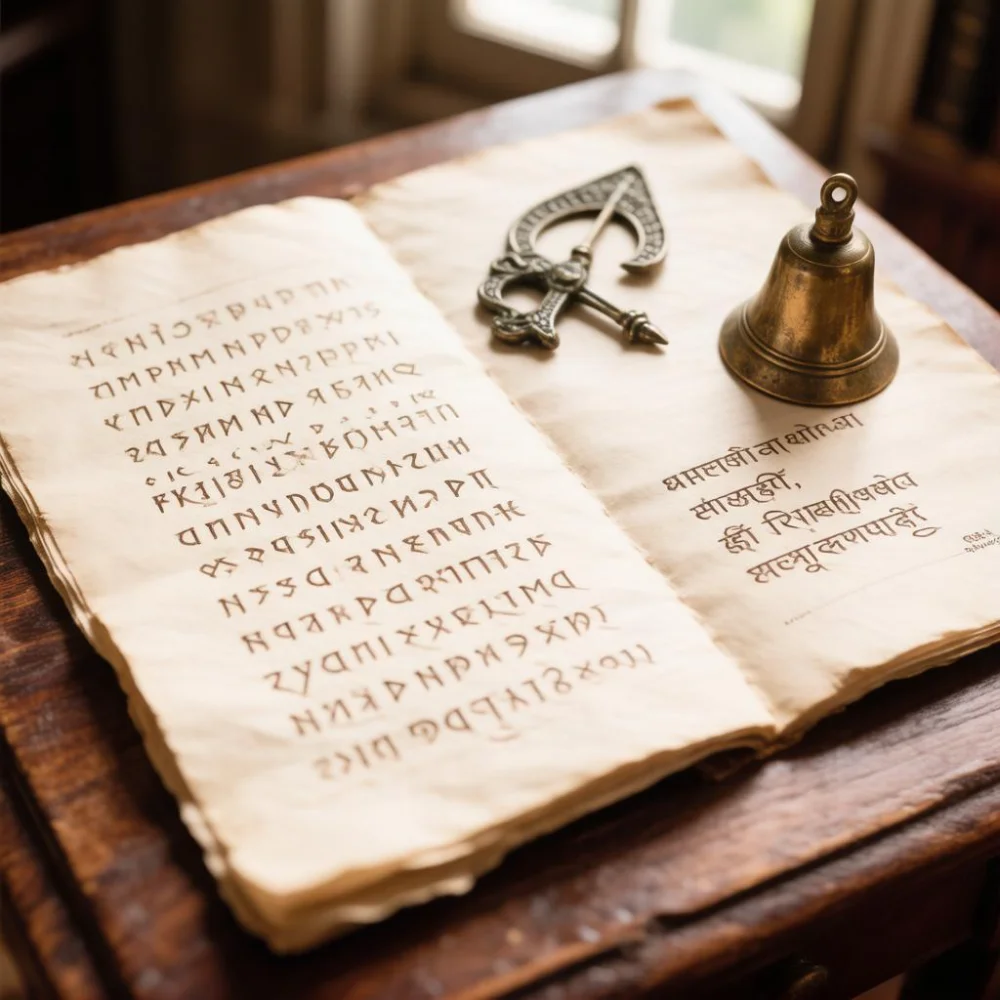
Irish and Indian mythology share numerous striking parallels. Both represent Indo-European mythic beliefs at a roughly similar level of evolution. Celtic cosmology is a parallel to Vedic cosmology. Ancient Celtic astrologers used a similar system based on twenty-seven lunar mansions, called nakshatras in Vedic Sanskrit. Like the Hindu Soma, King Ailill of Connacht, Ireland, had a circular palace constructed with twenty-seven windows through which he could gaze on his twenty-seven “star wives”.
One fascinating parallel is that the ancient Irish and Hindus used the name Budh for the planet Mercury. The stem budh appears in all the Celtic languages, as it does in Sanskrit, as meaning “all victorious”, “gift of teaching”, “accomplished”, “enlightened” and “exalted”. Buddha is the past participle of the same Sanskrit word – “one who is enlightened”.
The Song of Amairgen
Perhaps the most extraordinary example of shared mythology is the Song of Amairgen. According to Irish tradition, when Amairgen, the son of Golamh, set foot in Ireland, he cried out an extraordinary incantation that could have come from the Bhagavad Gita:
I am the wind that blows across the sea;
I am the wave of the ocean;
I am the murmur of the billows;
I am the bull of the seven combats;
I am the vulture on the rock;
I am a ray of the sun;
I am the fairest of flowers;
I am a wild boar in valour;
I am a salmon in the pool;
I am a lake on the plain
This ancient Irish poem, which subsumes all things into the speaker’s being, bears a striking resemblance to the cosmic declarations found in Vedic and Hindu scripture. It is a testament to the deep cultural connections that link Ireland and India across thousands of years.
A Shared Heritage
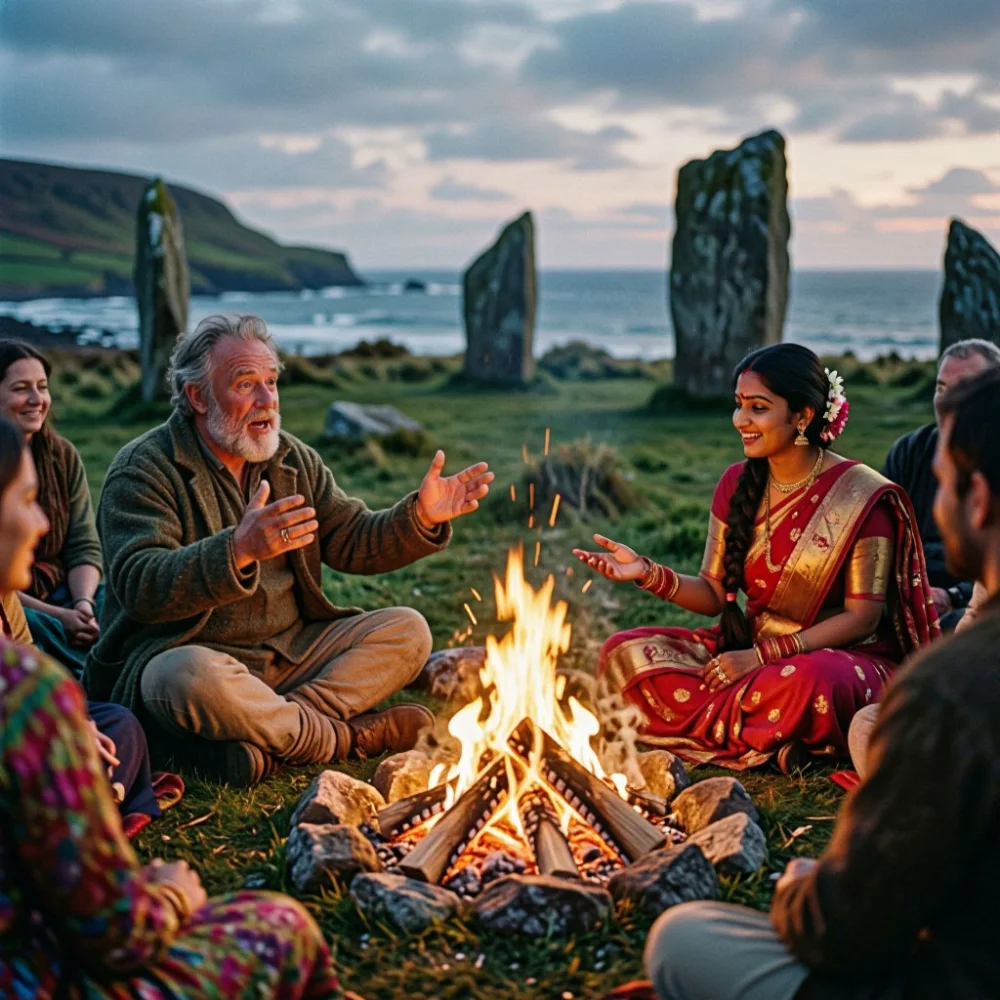
The folk tales, myths and cultural motifs shared between Ireland and India are not isolated coincidences. They are evidence of a common Indo-European heritage that has survived for millennia. From the Panchatantra to Christy Moore, from the Druids to the Brahmins, from the Song of Amairgen to the Bhagavad Gita – the connections are real and lasting.
These shared stories remind us that even nations separated by vast distances can be bound together by the tales they tell. They point to a kinship that transcends geography and time. And they continue to inspire new generations of writers, musicians and storytellers on both sides of the world.


