At the turn of the 20th century, few non-European writers captured the Western literary imagination as powerfully as Rabindranath Tagore. Central to his rise was William Butler Yeats, the towering Irish poet and co-founder of Dublin’s Abbey Theatre. Their friendship became one of the most celebrated literary connections between Ireland and India – a meeting of minds that transcended geography, culture and empire.
A Meeting of Minds in London
Tagore and Yeats first met in June 1912 at the house of English painter William Rothenstein in London. Tagore, then 51 years old, had come to Britain on his third visit. He brought with him the English manuscript of Gitanjali – his own translations of spiritual verses originally written in Bengali.
Yeats was presented with the manuscript and was immediately moved. He later wrote in his introduction: “I have carried the manuscript of these translations about with me for days, reading it in railway trains, or on the tops of omnibuses and in restaurants, and I have often had to close it lest some stranger would see how much it moved me”. For Yeats, Gitanjali was akin to scripture. He likened Tagore to the English poet William Blake and imagined India not as an exotic other, but as a mirror.
Yeats concluded with conviction: “If someone were to say he could improve this piece of writing, that person did not understand literature”. Thus began a celebrated association between the two poets that would change literary history.
The Introduction That Changed Everything
Yeats’s role in introducing Gitanjali to the English-speaking world is now a well-known story. His preface to the 1912 English edition was instrumental not only in launching Tagore into the global literary spotlight, but also in helping promote the book for the Nobel Prize.
The collection was first published in November 1912 by the India Society of London. It contained translations of 53 poems from the original Bengali Gitanjali, as well as 50 other poems from Tagore’s other works – 103 prose poems in total. Yeats’s framing proved decisive. Scholars contend that the Nobel committee’s internal report relied “entirely on Yeats’s introduction,” with the committee admitting that “no biographical information was included with the proposal”.
In his introduction, Yeats wrote of Tagore’s lyrics: “I know of no man who has done anything in the English language to equal these lyrics”. He described Tagore as “the first among our saints,” someone who rose above worldly strife.
The Nobel Prize and Its Aftermath
In 1913, less than a year after the book’s publication, Tagore became the first non-European to win the Nobel Prize for Literature. The citation praised his “profoundly sensitive, fresh and beautiful verse, by which, with consummate skill, he has made his poetic thought, expressed in his own English words, a part of the literature of the West”. Gitanjali: Song Offerings remains the only literary work by an Indian to have won the prize.
Within nine months of its first appearance, the book had to be reprinted ten times.
Yeats was himself awarded the Nobel Prize for Literature ten years later, in 1923. The two Nobel laureates – one Irish, one Indian – remained bound by the literary connection they had forged in that London meeting.
A Complicated Friendship
Their relationship was not without its difficulties. In later years, Yeats grew more critical of Tagore’s work, at one point dismissing him and feeling his reputation had been damaged. Yet the significance of their initial meeting and Yeats’s role in introducing Tagore to the West cannot be overstated. As one scholar noted, Yeats’s enthusiastic admiration for an Oriental poet contributed significantly to welcoming Tagore into the Western literary canon.
What drew Yeats to Tagore was the idea of a shared cultural memory that could bridge distant civilizations. Yeats imagined Indian culture “not because of its strangeness, but because it was like meeting our own image… our voice as in a dream”. He saw in Tagore’s verses a similar idealistic vision of universal unity.
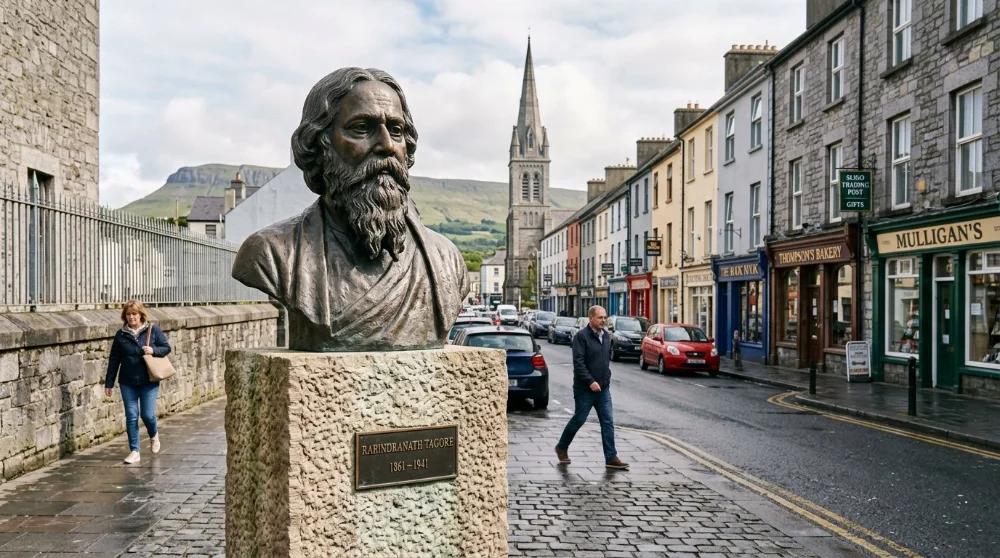
The Bust in Sligo: A Lasting Memorial
To commemorate this historic friendship, the Government of India gifted a bust of Rabindranath Tagore to the town of Sligo – the place most closely associated with Yeats. The proposal came about as part of the Yeats 150th Birthday celebrations in 2015. Minister John Perry announced the plan, noting: “I have received a very positive proposal from the Embassy of India in Dublin, as a way of paying tribute to WB Yeats and his renowned friendship with Rabindranath Tagore, to have a statue of Tagore commissioned and erected in Sligo”.
The bust was unveiled on Wine Street in Sligo during the 150th anniversary of Yeats’s birth. The ceremony was attended by an Indian government minister, the Indian ambassador to Ireland, and Ireland’s Minister for Justice and Equality Frances Fitzgerald. The Cathaoirleach of Sligo County Council later described it as “a very generous gesture from the Indian Government”.
The unveiling evening in City Hall was described as “a memorable and colourful pageant of music, readings, a vibrant reflection on the beauty of Indian culture and Heritage”. The bust now stands as a permanent reminder of the bond between two Nobel laureates – one Irish, one Indian – whose friendship helped bring Eastern poetry to the Western world.
A Legacy That Endures
The Yeats-Tagore connection has become an enduring representation of the Indo-Irish literary and cultural relationship. Their friendship continues to be remembered and celebrated, particularly in Sligo, where the Indian community has grown and thrived. The Tagore bust on Wine Street stands alongside tributes to Yeats himself, a fitting symbol of two poets who found in each other a shared vision that transcended the boundaries of nation and empire.
Their meeting in 1912 changed literary history. Yeats’s introduction to Gitanjali helped launch Tagore to global fame and secured him the Nobel Prize. The bust in Sligo, gifted by the Government of India, ensures that this remarkable friendship will never be forgotten. It stands as a bridge between two cultures, two countries and two Nobel-winning poets whose words continue to inspire readers around the world.