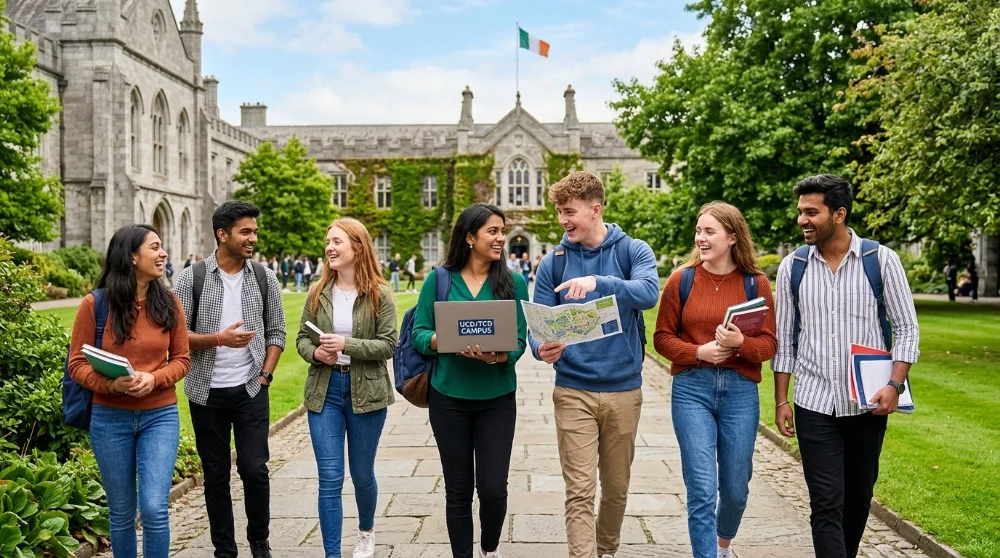
Education as a Bridge: The Rise of Indian Students in Ireland and Its Impact on Ties Between the Two Countries
The relationship between Ireland and India is often told through the languages of trade, history, and culture. But there is another story, just as significant, unfolding across lecture halls and campus quads. It is the story of education, and it is changing the very nature of the connection between the two nations.
Today, the number of Indian students in Ireland has hit a record high of over 15,000, making them the largest international cohort in the country . This is a dramatic rise from just 700 Indian students a decade ago . The country is quickly becoming a preferred destination, offering a compelling mix of quality education, a welcoming environment, and strong post-study career prospects.
A Strategic Shift in Partnership
This growth is not just about numbers. It represents a fundamental shift in how the two countries engage with each other in higher education. Ireland is moving beyond simple student recruitment toward building lasting institutional partnerships . As Ambassador Kevin Kelly has noted, the next phase will involve deeper collaborations, stronger university linkages, and eventually, Irish universities setting up campuses in India .
The Irish government is actively encouraging this evolution. Minister James Lawless has said that Ireland is looking to collaborate “every possible way with India’s higher education institutes whether it’s offering dual degree, student exchange programme or maybe setting up campuses in India” . This ambition is part of a broader strategy, with Minister Jack Chambers visiting tech hubs in Hyderabad to strengthen the education, technology and innovation links between the two countries .

What Makes Ireland Attractive?
For Indian students, Ireland offers a package that is hard to ignore. Irish universities provide globally recognised degrees, are taught in English, and offer a safe, student-friendly environment . One of the biggest draws is the post-study work visa, which allows graduates to stay in Ireland for up to two years to find employment . This is a significant advantage in a country home to the European headquarters of many global tech and pharmaceutical giants, offering a clear pathway from graduation to a career .
The cost is also a key factor. While not inexpensive, studying in Ireland is often more affordable than in the UK or the US. Tuition fees for non-EU students typically range from €10,000 to €25,000 per year for undergraduates and €10,000 to €35,000 for postgraduate programmes . Master’s programmes, in particular, are attractive as they are usually completed in one year, significantly reducing the total cost of the degree . Practical advice on managing finances is readily available, helping students budget for tuition, living costs, and the initial expenses of settling in .
Diaspora: The Living Bridge
The presence of over 15,000 Indian students in Ireland is profoundly affecting the broader relationship. They form the core of a vibrant and growing Indian diaspora, now estimated at over 100,000 people . These students create lifelong connections between the two countries, acting as a powerful “bridge” between cultures and economies. Many will stay in Ireland after their studies, contributing their skills to the Irish economy, while others will return to India with an appreciation for Irish education and culture . This people-to-people connection is the bedrock of a sustained and deepening partnership.

Challenges and the Road Ahead
The rapid growth in student numbers has not come without challenges. The Irish government has recently tightened student visa rules, introducing stricter financial proof requirements, a mandatory upfront tuition payment of €6,000, and compulsory biometrics at VFS centres in India . While these changes are designed to ensure that students are adequately prepared, they also raise the bar for applicants. For students, this means planning well in advance and ensuring they meet the new financial criteria.
Furthermore, while Irish universities are exploring the idea of setting up campuses in India, they are proceeding with caution . Unlike institutions from some other countries, Irish universities, being state-funded, must be careful with their spending . The focus in the immediate future will likely be on deepening partnerships and developing innovative academic programmes that can be delivered in partnership with Indian institutions .
A Pillar of the Relationship

The education sector is now a central pillar of the Ireland-India relationship, alongside the growing economic partnership. It is a powerful example of how practical collaboration can build a durable and multifaceted relationship. As the number of Indian students choosing Ireland continues to grow, and as Irish universities deepen their ties with Indian counterparts, the bridge between the two countries will only become stronger