On the morning of June 23, 1985, the world watched in horror as a tragedy unfolded off the coast of Ireland. Air India Flight 182, a Boeing 747 named “Kanishka,” was en route from Montreal to New Delhi via London. At 8:13 am, a bomb planted by terrorists exploded in the cargo hold. The plane broke apart in mid-air at 31,000 feet and crashed into the Atlantic Ocean, about 160 kilometers off the southwest coast of Ireland. All 329 people on board – 307 passengers and 22 crew members – lost their lives. Among the dead were over 80 children. It remains the worst aviation disaster in both Irish and Canadian history.
For the grieving families scattered across the globe, the immediate aftermath was a nightmare of uncertainty and pain. But in that darkness, they found an unexpected light. It came from a small, close-knit community in West Cork, Ireland, that opened its arms to complete strangers.
A Community’s Unwavering Kindness
As families of the victims travelled to Ireland to search for answers and to retrieve the remains of their loved ones, they were met with extraordinary compassion. The people of Ahakista and the wider Cork community did not see the victims as foreigners. They saw them as fellow human beings in desperate need of comfort.
Local residents opened their homes and their hearts to the bereaved families. They shared in their grief, offering shelter, food, and a shoulder to cry on. For many families, this kindness became a lifeline. Lata Pada, who lost her husband and two daughters in the tragedy, expressed this profound gratitude at the 20th anniversary ceremony. She said: “I say thank you with deep gratitude to the people of Ireland for their incredible compassion and human kindness that they showered on us. We believe this was a gift given to us even in our darkest despair and grief”.
Usha Thampi, who was only six when she lost her mother, spoke of the deep bonds that were formed. “They shared our pain, shared our tears, placed us in their hearts. We have formed deep friendships with many of them”. Padmini Turlapati, who lost her two young sons, added: “Your love gave us the will to live on. We developed a kinship with you as you represent the best of humanity”.
The families noticed the meaning behind the name of the village itself. Ahakista translates to “bridge” in Irish. And that is exactly what it became – a bridge of friendship and solidarity between the victims’ families and the people of Ireland.
The Ahakista Memorial: A Place of Pilgrimage
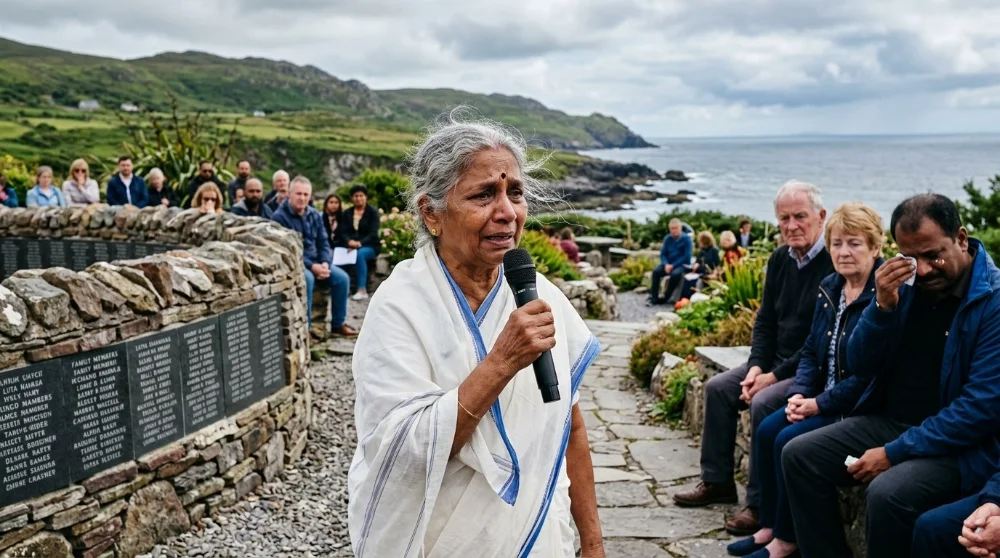
The bond forged in 1985 was made permanent with the creation of a memorial. Relatives of the victims chose the spot at Ahakista on the Sheep’s Head Peninsula because it was the closest point of land to where the plane went down. The land was donated by Cork County Council.
On June 23, 1986, the first anniversary of the bombing, the Ahakista Memorial was unveiled. Sculpted by Cork artist Ken Thompson, the memorial consists of a peaceful garden, a large stone sundial, and a rounded stone wall. The wall is inscribed with the names and images of each of the 329 people who died.
The sundial is a particularly poignant feature. It was donated by the people of Canada, India, and Ireland. Every year on June 23 at 8:13 am – the exact moment the bomb exploded – the shadow of the sundial falls on a specific spot, marking the precise time of the tragedy. A plaque beside it simply states: “Memorial: To all those who died in 1985. Erected by the people of Canada, India & Ireland”.
The memorial garden has since become a place of pilgrimage. Families travel from Canada, India, and across the world to visit this quiet corner of Ireland. For them, it is hallowed ground.
An Annual Tradition of Remembrance
Since the memorial’s unveiling, an annual commemoration has been held at Ahakista every June 23. The service is simple and dignified. It begins at 8:13 am with a minute’s silence. Family members, Irish locals, and dignitaries gather at the wall bearing the names of their loved ones.
Over the years, the ceremony has grown in significance. In 2005, on the 20th anniversary, Canadian Prime Minister Paul Martin became the first Canadian leader to visit the memorial. Irish President Mary McAleese also attended, and together they released 329 white balloons and 331 paper lanterns into the Atlantic. The two extra lanterns were for two Japanese baggage handlers killed in a related bombing at Narita Airport on the same day.
Even when families could not travel, the people of Ireland ensured the remembrance continued. During the COVID-19 pandemic in 2020, when travel restrictions prevented families from coming to Ireland, Cork County Council organized an online ceremony. Mayor Ian Doyle participated in a YouTube remembrance, joined virtually by families from Canada and the Ambassador of India. The council laid wreaths on behalf of the families, the governments of Canada and India, and the people of Cork. Children from the local Ahakista National School even recorded music for the virtual service.
From Tragedy to Lasting Friendship
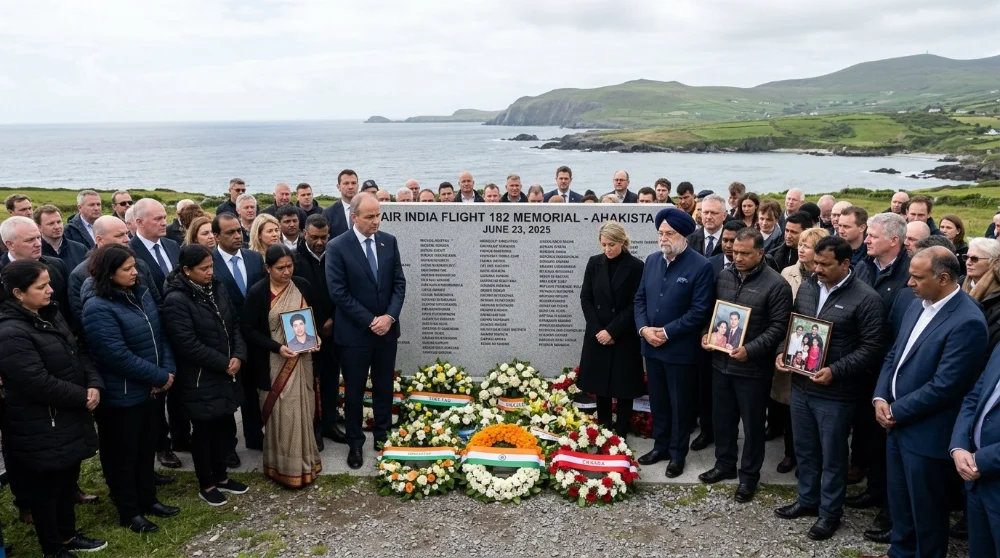
The 40th anniversary in 2025 was a particularly significant moment. For the first time, India, Ireland, and Canada united in a tri-national commemoration. An Indian delegation led by Union Minister Hardeep Singh Puri joined Irish Taoiseach Micheál Martin and Canadian Minister Gary Anandasangaree at the Ahakista Memorial. Around 60 family members and 200 others attended the service.
Taoiseach Micheál Martin spoke of the enduring impact of the tragedy: “Some 329 innocent people lost their lives over the skies of Ireland that morning, and the passing of time does not dim the scale of the tragedy”. He noted the heartbreaking descriptions on the memorial wall – “Student” or “Child” – and said: “So many young lives taken far too soon”.
Minister Hardeep Singh Puri echoed these sentiments and called for global unity against terrorism. He stressed that the tragedy was not an accident but a “deliberate, heinous act”. He also expressed deep gratitude to the people of Ahakista and the Irish government for their compassion. He noted that the unique friendship forged in the wake of the disaster has blossomed into strong bilateral ties, with trade between India and Ireland reaching nearly $16 billion in 2023. The bond forged in tragedy, he said, has “blossomed into a thriving partnership”.
The story of the Air India “Kanishka” tragedy is one of unimaginable loss. But it is also a story of profound humanity. A small Irish community, confronted with a horror beyond comprehension, chose compassion over indifference. They opened their homes and their hearts to grieving strangers and never stopped remembering. In doing so, they forged a bond that has lasted for decades and continues to grow stronger with each passing year.