The story of Indians in Ireland is older than many people realise. Long before the large Indian community of today, individual Indians made their way to Irish shores. They came as sailors, servants, soldiers and scholars. Two of the most remarkable early Indians in Ireland were Dean Mahomet, who arrived in the late 1700s and wrote the first English-language book by an Indian, and Mir Aulad Ali, who became a professor at Trinity College Dublin a century later. Their stories show that the connection between India and Ireland goes back much further than modern times.
Dean Mahomet: The First Indian Author in English
Dean Mahomet was born in 1759 in Patna, Bengal. At the age of 11, his life took a significant turn when he met Captain Godfrey Evan Baker, a member of a notable Southern Irish family from Cork who worked for the East India Company in India. Mahomet entered the service of the East India Company and spent fifteen years in its army. He served as a camp-follower, servant and subaltern officer.
In January 1784, Mahomet and Baker sailed from Calcutta. Later that year, at the age of twenty-five, Mahomet arrived in the Irish port of Cork. He began living with the Baker family and created a new life for himself. Through his patron, he gained access to the Anglo-Irish Protestant elite, though he stood separate from them in origin, colour and culture. He did not fit among the colonised Catholic Irish peasantry either. A few other Indians passed through or lived in Cork at the time, including Indian sailors, servants, wives and mistresses, and their Anglo-Indian children. But Mahomet’s situation remained quite different from any of theirs.
Soon after his arrival, Mahomet began to study under the Bakers’ sponsorship to advance his education. He particularly cultivated his knowledge of English language and literature. As shown by his writing, he mastered the polished literary forms of the day, complete with poetic interjections, erudite allusions and classical quotations in Latin.
In 1786, the same year his patron Godfrey Evan Baker died, Mahomet eloped with a teenage student named Jane Daly. She came from a Protestant Irish gentry family. The marriage was unusual for its time. Any wedding between a Protestant and a Catholic was unlawful in Ireland then, and the officiating clergyman could be held responsible. Mahomet must have already become a member of the established Protestant Church.
The First English Book by an Indian
In 1794, Mahomet published his two-volume memoir in Cork. It was called The Travels of Dean Mahomet, A Native of Patna in Bengal, Through Several Parts of India, While in the Service of The Honourable The East India Company, Written by Himself, In a Series of Letters to a Friend. This book is considered the first English-language book written by an Indian. It was also the first account of the imperial process from an Indian’s perspective that was intended directly for an anglophone audience in Britain.
The book was published by subscription. Mahomet received subscriptions from 320 people, most of whom belonged to the social elite of Munster. Over 85 percent of the 238 male subscribers were gentlemen distinguished by a title, rank, or the epithet “esquire”. This was proof that Ireland’s leading citizens regarded him as a man of culture. The book presented an Indian’s view of the British conquest of India and conveyed the vital role taken by Indians in the colonial process. Mahomet wrote in an epistolary style – a series of letters to a friend. Interestingly, he made no mention of his time in Ireland in the book.
Life in Ireland and Beyond
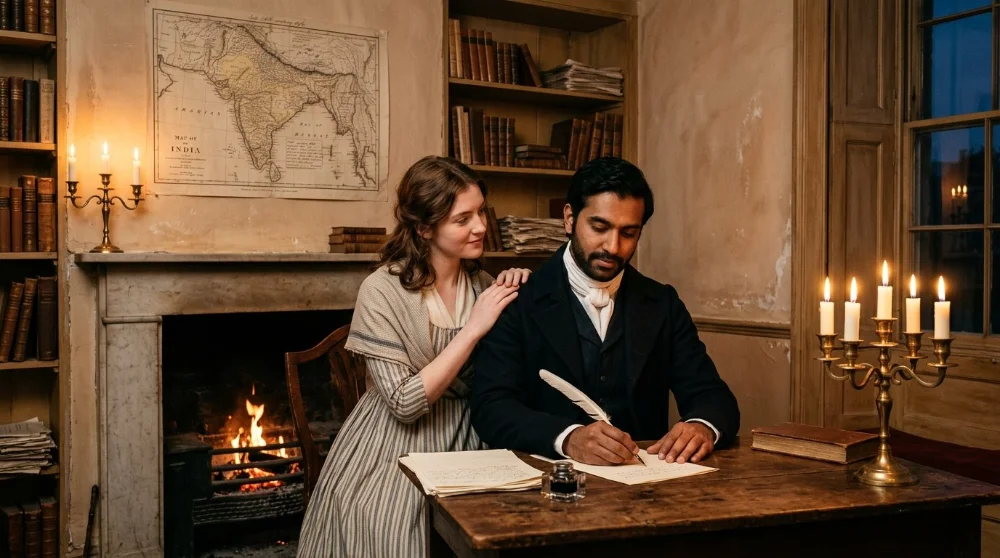
Mahomet and his growing Anglo-Irish-Indian family remained in Ireland for over two decades. In 1799, while living at Fortwilliam near Cork, he met another Indian traveller, Abu Talib Khan, a self-proclaimed “Persian Prince”. Khan later wrote about this meeting in his own travel account, describing how Mahomet had married and had children.
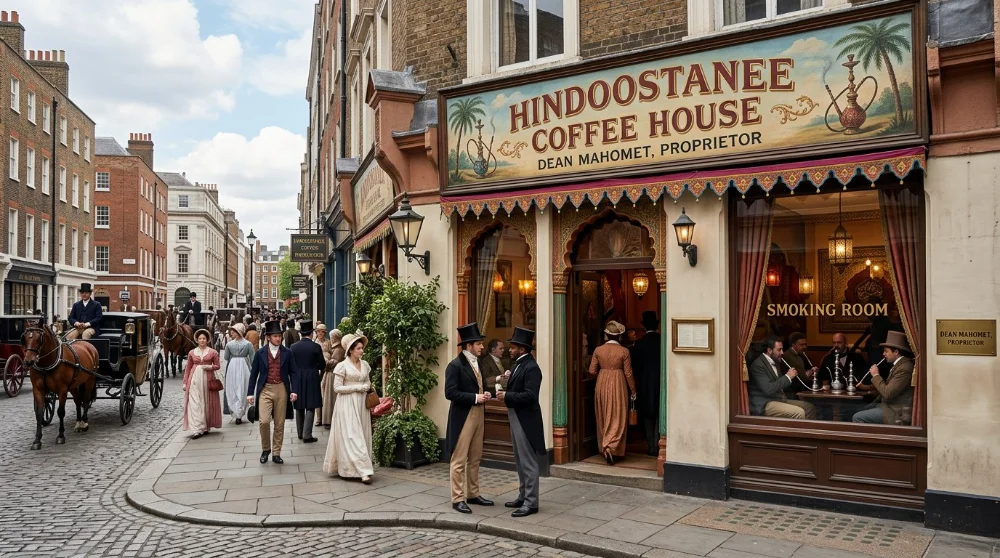
Around 1807, Mahomet and his family emigrated to London. There he established the Hindoostanee Coffee House near Portman Square, which offered Indian dishes, a separate smoking room with hookahs and Indian décor. This is believed to have been the first Indian restaurant in Britain. But the business ran into financial difficulties.
By 1814, Mahomet had begun his most successful business – a bathhouse in Brighton. His wife Jane was actively involved, conducting treatments which included Indian Medicated Vapour Baths and Shampooing with Indian Oils. Mahomet was appointed Shampooing Surgeon to the King, having received royal patronage. By the time of his death in 1851, he had produced more books, invented more treatments and developed a line of merchandise.
Historian William Dalrymple described Mahomet as “constantly charming and infinitely adaptable, intelligent and sharpwitted, part charlatan and part Renaissance man”. His life was a testament to self-determination, resilience and sheer inventiveness.
Mir Aulad Ali: Professor at Trinity College Dublin
Almost a century after Dean Mahomet arrived in Cork, another Indian made his mark in Ireland. Mir Aulad Ali was a native of North India who became a professor at Trinity College Dublin in the latter half of the 19th century. He was appointed Professor of Arabic, Hindustani and Persian at Trinity College.
His appointment was a significant achievement. Trinity College Dublin was one of Ireland’s most prestigious institutions. For an Indian scholar to hold a professorship there showed that the intellectual connections between Ireland and India were growing stronger. Mir Aulad Ali was active in this role from around 1878 to 1880. Photographs of fellows and professors of Trinity College Dublin from that era include his name among the distinguished academics of the time.
A Complex Identity
Mir Aulad Ali’s story highlights the complexity of multiple identities. He was a Muslim scholar in a predominantly Christian country. He defended Islam from slander, though there is little evidence that he was strict in religious observance. His position was paradoxical in some ways. He was part of the intellectual elite of Dublin, yet he continued to train British Civil Servants for India.
His case also shows how ideas of independence and nationalism were spreading in educated circles in both Ireland and India. The 19th century brought about a shift in how both countries viewed one another. Both increasingly sought to establish movements that questioned the colonial hold of the British Empire. Mir Aulad Ali was part of this changing world, living at the intersection of two cultures that were both struggling to define their relationship with Britain.
A Lasting Legacy
The stories of Dean Mahomet and Mir Aulad Ali are remarkable for different reasons. Mahomet was a migrant who built a new life in a foreign country, married into Irish society, and achieved something no Indian had done before – publishing a book in English. Mir Aulad Ali reached the heights of Irish academia, becoming a professor at one of the country’s oldest universities.
These early Indians in Ireland were pioneers. They paved the way for the many thousands of Indians who would come to Ireland in later years. Their stories show that the connection between India and Ireland is not just about the Irish who went to India, but also about the Indians who made Ireland their home. From Dean Mahomet’s arrival in Cork in 1784 to Mir Aulad Ali’s professorship at Trinity College a century later, the Indian presence in Ireland has been part of the country’s history for far longer than most people realise.